It really bothers me to hear this, because the truth is people have unlimited wants, and there will always be rich and poor, whether by context or by deed. Growth is the only way I see where we can hope to lift all boats. An anti-growth mentality kicks the ladder from underneath those who might benefit from increased material wealth.
In this context, I'm really proud of my ancestral homeland (mainland China), who in 40 years lifted a billion people from abject poverty through economic growth. Yes, there's significant problems magnified by that, but to paraphrase a popular saying, a full person has a million problems and a starving person has one.
Sure, growth with negative externalities have negative side effects and we definitely should talk about that, but that's a separate discussion and focus than "don't grow".
I totally agree with your leverage aspect and aligning value to utility, and I think that's a very positive avenue of discussion. Let's talk about that instead.
Exponential growth literally cannot continue indefinitely on a planet with finite land, finite energy reserves, and finite resources. This should be uncontroversial.
We can disagree about where, when, and how to stop growth. We cannot disagree that it must stop at some point, and that the tyranny of exponential growth means that you will hit this moment frighteningly fast even when you appeared to have plenty of legroom. With a growth rate of even 1.5%, you can be using less than 10% of the resources available to you, and yet you will hit a hard wall at a minimum within 200 years. And even this is a fantasy, as resources, land, and energy are always utilized in decreasing order of ease of access.
You're misdefining growth. Growth in no way has to be dependent on physical resources, and in fact isn't.
Growth is just as much about increasing efficiency. If you continue to chop down the same amount of sustainable wood year after year, but figure out how to do it at half the price (e.g. because robots), that's 100% growth.
Indeed, look at the huge growth in the services industry over the past several decades. That's not using up extra land, energy, etc.
Now growth can involve using up more resources, or it can not, or it can be a mix. But the problem you seem to have is with resource consumption, not with economic growth generally.
I am emphatically not doing that. Efficiency gains and “services” simply cannot fuel unlimited exponential economic growth, end of story. You can chop your tree for half the energy use tomorrow, but not the next day and the next and the next and the next. And unfortunately, we’re way closer to optimal efficiency for the tasks that we want to accomplish than you may want to believe. There simply aren’t many more 100% efficiency gains to be had anywhere economically meaningful.
At the end of the day, our access to energy is finite. And not simply from a perspective of resources. We are literally a few hundred years shy[1] of heating the Earth to uninhabitable levels from a pure thermodynamics perspective (e.g., entirely ignoring global warming from greenhouse gases, and considering Earth as a simple blackbody radiator).
If you somehow believe that we can have unlimited economic output from finite energy and finite resources on this planet I’m not sure there’s any point in me continuing to debate an argument rooted in magical thinking.
> You can chop your tree for half the energy use tomorrow, but not the next day and the next and the next and the next.
Why not? If we're talking decades rather than days, a combination of AI and solar power will eventually get us to the point where virtually no human effort is required at all.
Economic efficiency has nothing to do with energy efficiency, it's entirely about the efficiency of human inputs.
In fact, a significant amount of economic growth comes from learning how to accomplish the same tasks with less energy -- more fuel-efficient cars, lightbulbs, and so on.
Energy and thermodynamics have absolutely nothing to do with it.
There's no magical thinking here. You're just confused that you think economic growth requires greater energy usage. It doesn't. And I don't know where you've gotten the idea that it does.
And your link is misleading -- just because energy production has accompanied economic growth doesn't mean it always will, or that it does in every sector. It just means it's been the pattern so far, because energy is cheap. As soon as energy becomes more expensive, growth consists in using it even more efficiently and renewably.
> If we're talking decades rather than days, a combination of AI and solar power will eventually get us to the point where virtually no human effort is required at all.
I'm not talking about human effort. Price is related to energy input. And there's only so efficient you can get at chopping down that tree.
> And your link is misleading -- just because energy production has accompanied economic growth doesn't mean it always will, or that it does in every sector. It just means it's been the pattern so far, because energy is cheap. As soon as energy becomes more expensive, growth consists in using it even more efficiently and renewably.
It is not misleading, you simply misunderstand the impact. Again, there's only so efficient you can become in any system. And we're already shockingly close to optimum in many of our systems. Getting closer and closer to those optimums is obviously possible, but it's ever-diminishing returns.
It is controversial, because the assumption of exponential growth is flawed. For one, your model underfits population growth, it's a logistic curve and not a purely exponential one. Wealthier countries on average produce less children than poorer countries, and assuming no global shakeup occurs, most will end up in the crisis like the one Japan is beginning to see with a lot of older people and not enough younger people to support them. We can talk about what happens after that cliff, but how can you have exponential usage in natural resources when the population _doesn't even exist_?
Not to mention human ingenuity when people get desperate. WWI / WWII saw Germany produce coffee from acorns, oil from coal, and Fanta from vegetable scraps, ensuring a rise in industrial production during 1944 under arduous circumstances. We don't operate at 100% efficiency and we can most definitely increase that number by double digit, maybe even triple digit percentages. Take meat, a horrible source of energy inefficiency. Lab grown meats, meat substitutes grown from vertical farms, even eating different kinds of meats (cricket powder protein bars aren't bad and have a more or less 1:1 energy input:output ratio) result in increased efficiency savings. This is a matter of economics.
Anti-growth simply isn't feasible from a domestic or foreign policy standpoint. There is no way you will convince any significant politician, and by extension his/her voting bloc, that there must be an end to growth. You can't religion or dictator your way out of this either, since it goes against the very essence of human nature.
Nothing I said is rooted in a belief that population growth will continue unabated. You yourself asserted that people’s wants are unlimited. That may be true, but people’s wants are never going to override the cold reality of finite supply.
Finite supply exists even if population growth declines. Finite supply exists even if population declines. Finite supply exists even if it’s untenable from a policy perspective. The expectation of continued unending exponential growth baked into our economic system will run up against the actual limits of what the Earth is capable of providing.
Again, this should not be controversial. Playing games about population growth is simply dodging the fact that even given a population of two humans, any greater-than-one exponent on economic activity will end. The logistic curve exists precisely because of this fact.
There's a whole universe out there. Europe had "finite land" until it got to the point where the demand for new territorial acquisitions became so high that governments financed colonization of 2 whole new continents. Why wouldn't this be the case with space exploration?
It’s hard to come up with a succinct reply to highlight how utterly absurd this argument is. From virtually any physics-based perspective, any kind of space travel or space-faring economy outside of very, very near Earth is unavoidably an net-negative venture[1]. Shipping energy from anywhere outside of Earth’s gravity well costs more energy, even at theoretical optimum efficiency, than it has any chance of gaining.
It’s not just that it’s difficult, from any meaningful angle it requires us to have completely misunderstood the relevant physics. If your argument relies on us discovering that all of known physics isn’t just off a bit or needing of refinement, but is completely misguided… well, that’s your prerogative I suppose.
Even if you hypothesize a space-colonizing human race, that does nothing for the people who are still stuck on Earth with Earth’s finite resources.
Some people have unlimited wants. I just want to do interesting work, work with interesting people, and take walks with my dog. I'm pretty basic, I don't enjoy or have any interest in fancy automobiles, big houses, vacations, air travel, etc.
> I just want to do interesting work, work with interesting people, and take walks with my dog.
You've fulfilled all of your material needs and now you're in the self-actualization phase of the hierarchy of needs. It took decades of economic growth driven by other people to get your society to the point where people like you care more about fulfillment in their profession rather than food security.
Some people are still subsistence farmers and they need a lot of economic growth to get to the point where they can worry about fulfillment in their professions and taking their pets for a recreational walk.
Why should you get to benefit from the economic growth in your own society while telling others they don't get to have that?
No serious antigrowth argument is saying China ought to stay at it's 20th low point.
The problem is there is growth that solely exists to feed the capitalist Leviathan vs growth that is actually giving people what they want, and they are hard to disentangle under capitalism. You could the first is trying to disguse itself.
> No serious antigrowth argument is saying China ought to stay at it's 20th low point.
Nobody says that outright, but that is what would have happened if their arguments had been translated into policy in the 1970s. And it is what would happen to poor countries today, if anti-growth arguments were adopted today.
And yet... growth will end. It will end because we choose for it to end, or because we've over-mortgaged the resources we have available to us and experience a collapse.
Bacteria in a sealed jar will continue to multiply until they've consumed all the available nutrients, at which point their population collapses. If you constantly add a trickle of nutrients to the jar, this behavior still happens, just with violent yo-yo'ing between collapse and growth until an eventual steady-state is reached.
We can argue whether or not we've exceeded the replenishment rate We can argue how far it's reasonable to go past this point if effects won't be felt for thousands of years. But there is simply no argument to be made that we can continue growing endlessly and exponentially past the replenishment rate of the ecosystem we live in.
Personally, I think we're well past the replenishment rate. Our ecological impact is causing systemic collapse in multiple areas: our climate is warming past dangerous thresholds, our oceans are acidifying and being depleted at an alarming rate, our oceans are rising at an accelerating rate, and we're experiencing unprecedented rates of of extinction of both animal and plant life. We're running out of sand (to make concrete with) for fuck's sake.
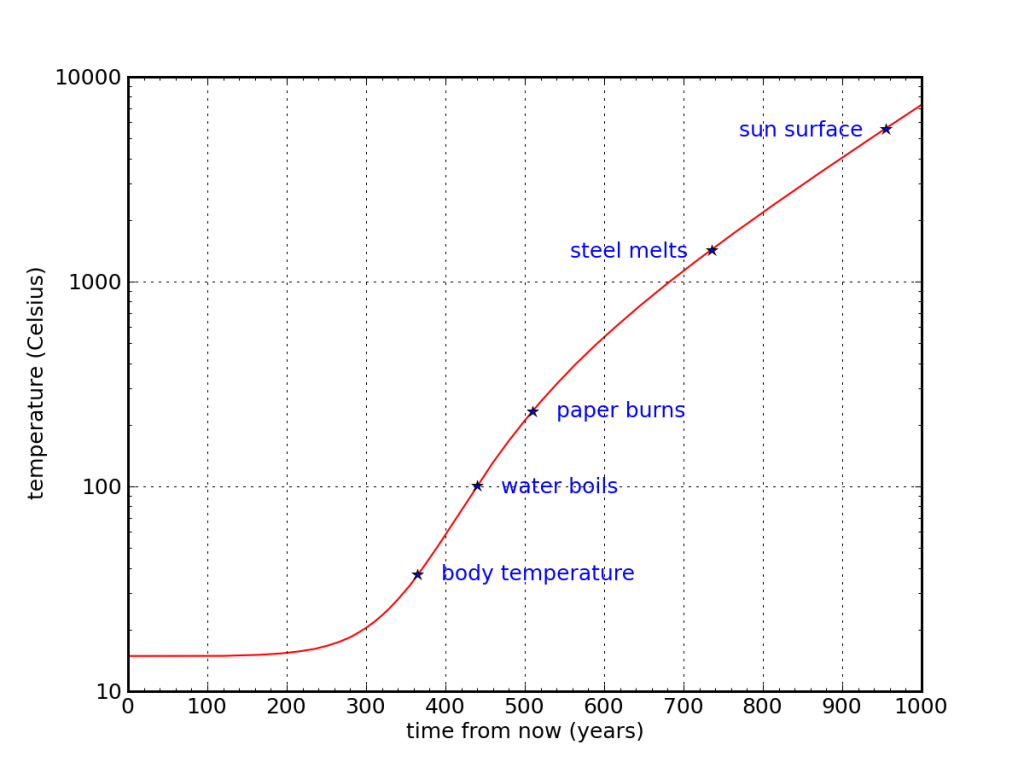
On top of this, at current rates of energy growth, we'll literally cook the Earth within two or three hundred years[1]. And I'm not talking about greenhouse gases: just from a raw thermodynamics perspective. Put enough energy capacity on Earth and it will eventually take the form of waste heat. Even in the complete absence of carbon dioxide, the only way for that heat to escape Earth is by being radiated into space. And there's only so fast a perfect blackbody with the surface area of the Earth can get rid of that heat. Even if the Earth were a perfect radiator (it isn't), this[2] is what our future looks like.


In this context, I'm really proud of my ancestral homeland (mainland China), who in 40 years lifted a billion people from abject poverty through economic growth. Yes, there's significant problems magnified by that, but to paraphrase a popular saying, a full person has a million problems and a starving person has one.
Sure, growth with negative externalities have negative side effects and we definitely should talk about that, but that's a separate discussion and focus than "don't grow".
I totally agree with your leverage aspect and aligning value to utility, and I think that's a very positive avenue of discussion. Let's talk about that instead.