I wonder at what speed you get that range. Those specs are in Bugatti Veyron league, even beating it at acceleration (for 1/8 the price tag), but at full speed, the Veyron empties its full tank in... 12 minutes. I'll let you calculate how many miles that is at 250mph.
I seem to recall reading that the Veyron's tyres will disintegrate after 15 minutes at top speed, but that's OK because it only carries fuel for 12 minutes.
Most of the car do since tank is sized to fuel consumption and full throttle petrol eat a lot of fuel - even a smart can reach 2km to the liter flat out and I know my alfa tank would only last 15 minutes give or take from the figures I got lapping at Monza
The Model S can seemingly do it quite often, Tesla Racing Channel does it quite a bit. You will thermal limit at some point but having twice the battery capacity is probably helping there.
The Porsche CEO has been sorta claiming that but it doesn't make sense to me. The kinetic energy of your car at a given speed is the same, regardless of how fast you accelerated to get to that speed. Do batteries waste more energy when you drain them faster?
They can't waste a large portion of battery capacity, because the heat from that much energy getting wasted would blow up the car.
Drag. Recall, wind resistance is proportional to the square of velocity. The vast majority of energy goes into overcoming drag, even at regular highway speeds. Remember when we capped speed limits at 55mph during the '70s energy crisis? We did so because fuel efficiency really starts to drop off at faster speeds. 250mph is very, very far up this curve.
It takes more power to accelerate faster but the total change in kinetic energy is the same either way. Any energy consumption that doesn't go into the final kinetic energy is going into waste heat, and there can't be too much of that without melting things.
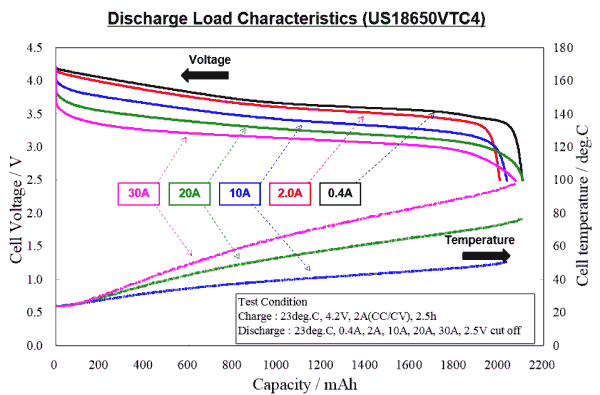
All of the electrical systems waste more energy if you drain them faster. To drain them faster you need higher currents which lead to higher waste power. Waste power goes up with the square of the current (P=I^2*R). This is most apparent in batteries heating up due to their internal resistance. Here's [1] an 18650 lithium cells discharge graph at different currents.