I think being able to A/B test price is invaluable for them. They can't cut prices by 50% and hike it again. By letting others slash the price, they can tell if it is worth it or not to do this officially.
possible. Since Pi exposes so much, it is very easy to build advanced tooling around it to help easily grok hundreds of tool calls to help you understand what they agent knows and what it has tried.
The solution that I am working on is designed to leverage cheap LLMs (think MiMo, GLM, etc.) to build cheap context to reduce tokens, but most importantly to keep the context clean.
> Claude Code has largely won individual developer mindshare and has been on top ever since it came out.
Claude Code's success is not due to the agent but because the model is considered the best for programming and is very heavily subsidized, compared to pay as you go API prices. Consumers and Enterprise are not really locked in and will go where it makes the most sense.
I think they have almost no loyalty by actual developers.
This isn't a perfect survey, but I am a Codex user and most of my employees are pretty stuck in their workflows and were not really interested in trying even when I was saying good things (even pre-Opus 4.8).
When we work trial people, 100% of people ask for Claude rather than Codex or anything else.
When I talk to people at non-AI tech events everyone basically says they use Claude and have not tried an alternative.
Developers writ large are actually not that interested in trying multiple tools, they like customizing their chosen tool and tweaking it forever.
I think developers are as susceptible to brand marketing as everyone else. It's why almost everyone has a Macbook.
There is no reason to be loyal....There is no moat.
Basically you may choose to drink brand A water bottle, brand B water bottle or tap water. Oh and you might choose the glass water bottle if you use API/Fable.
There’s no reason to be loyal, but I guess it’s a bit like any tool, once you get used to how one works why would you change to another? There is some stickiness with an LLM + harness.
Exactly developers can switch to another coding cli and the learning curve is close to zero. Mindshare without switching costs is just a popsicle in the sun.
Claude Code (or any other model/infra/harness co-design) is not subsidized in any normal use of that word. It's trough filling (I've written this up in lurid detail so I'm only going to do it again if anyone cares).
Nah, these harnesses like Claude Code and Codex are very sticky, I don't see many coworkers switching often, as they have set workflows for their particular harness. It's like vim and emacs, once you pick one it's unlikely you'd switch especially as the models are all "good enough" by now.
Every model has its strengths and weaknesses, being loyal is suboptimal unless you mean being loyal to all of them, which is why cursor would have been well positioned before it got acquired. Now you have to jump through hoops to call Gemini from Claude from codex. Yuck.
Claude code was one of the first agentic code tool and when openai release models similar in performance they didn't do as well in their tools (now codex)
> you can use /tree to go back before the compaction
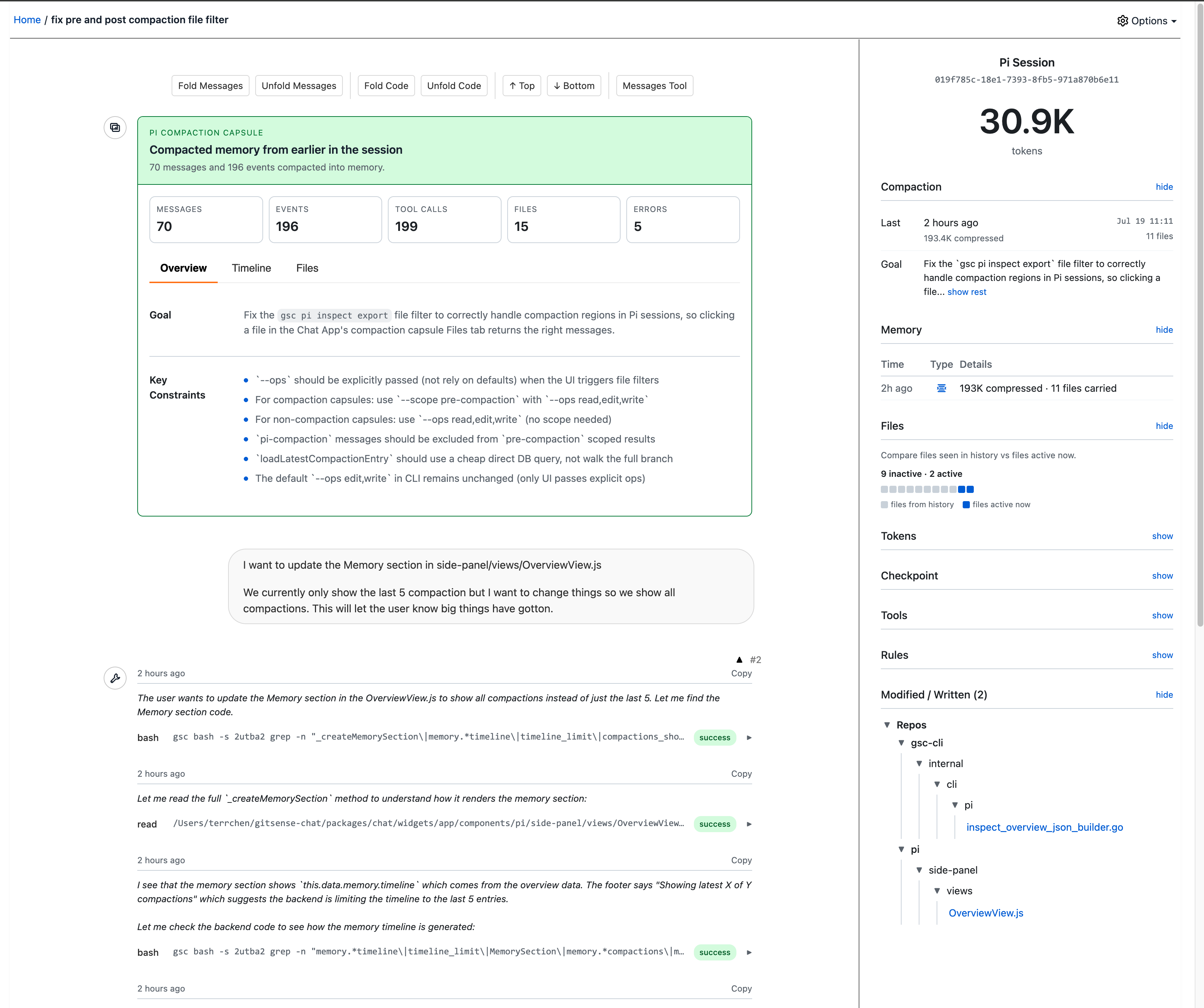
This is really a killer feature in my opinion. I'm currently working on pi brains extension that is designed to solve the compaction issue I have, which is, I don't know what the AI knows after compaction.
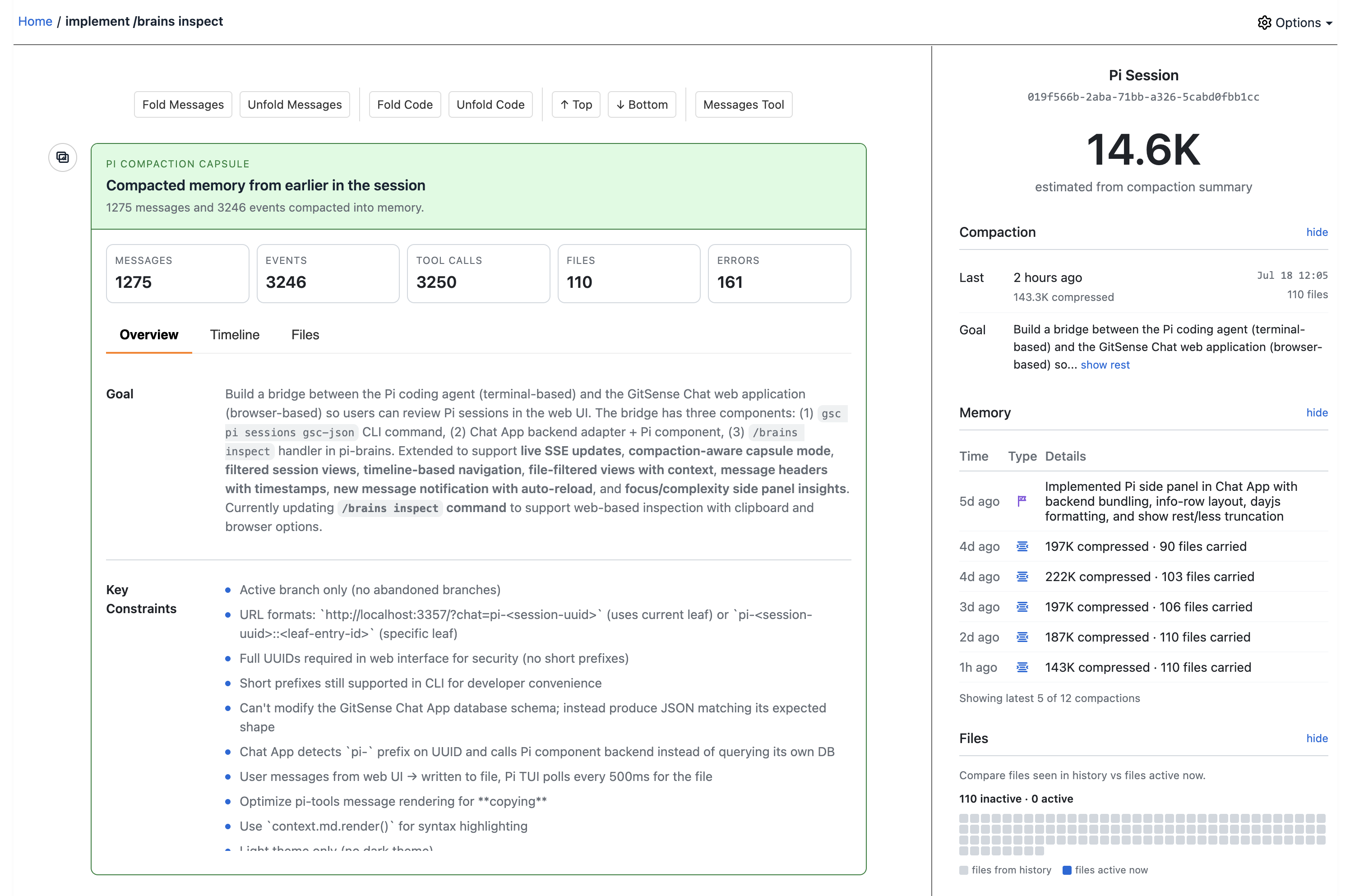
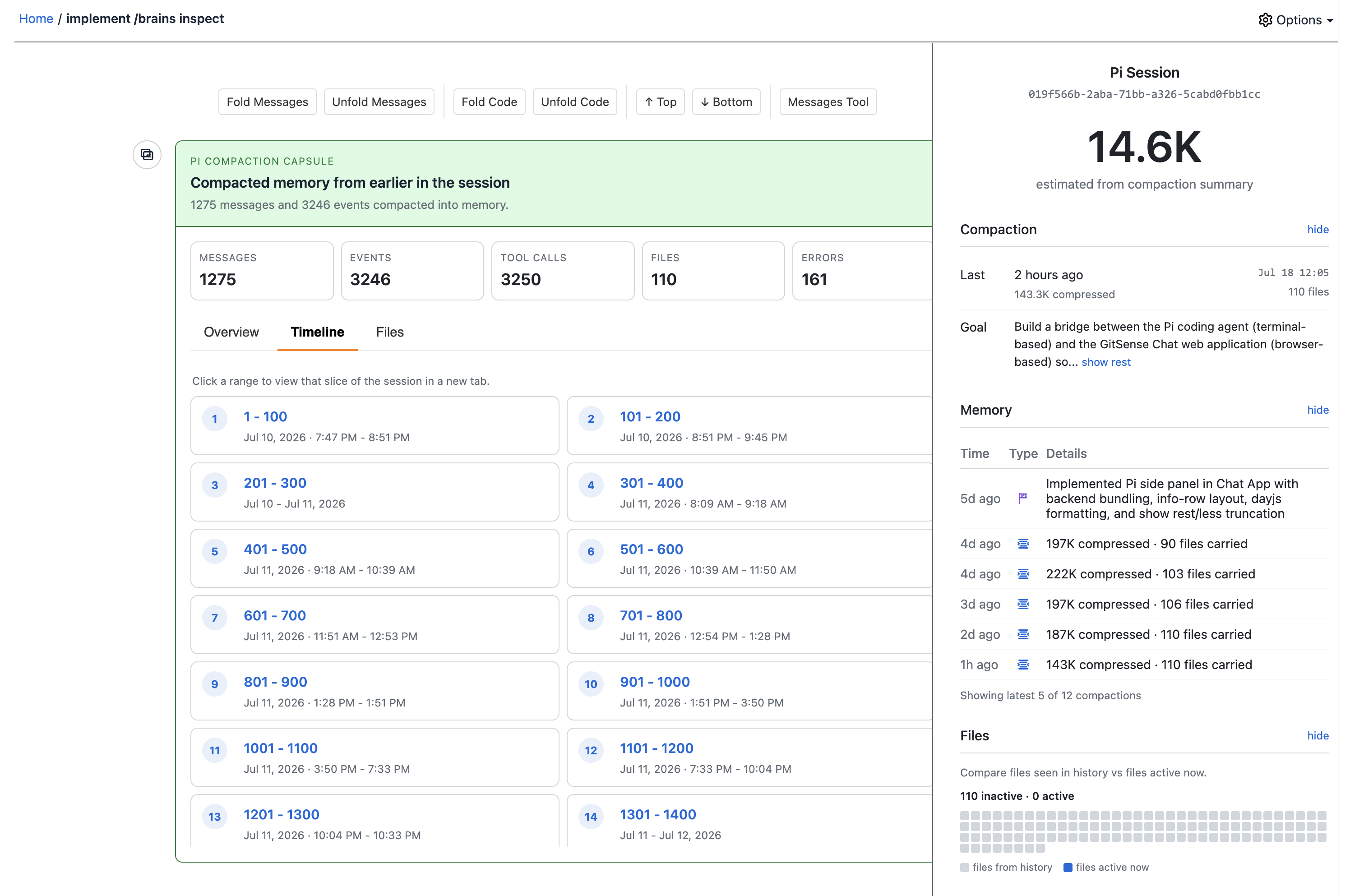
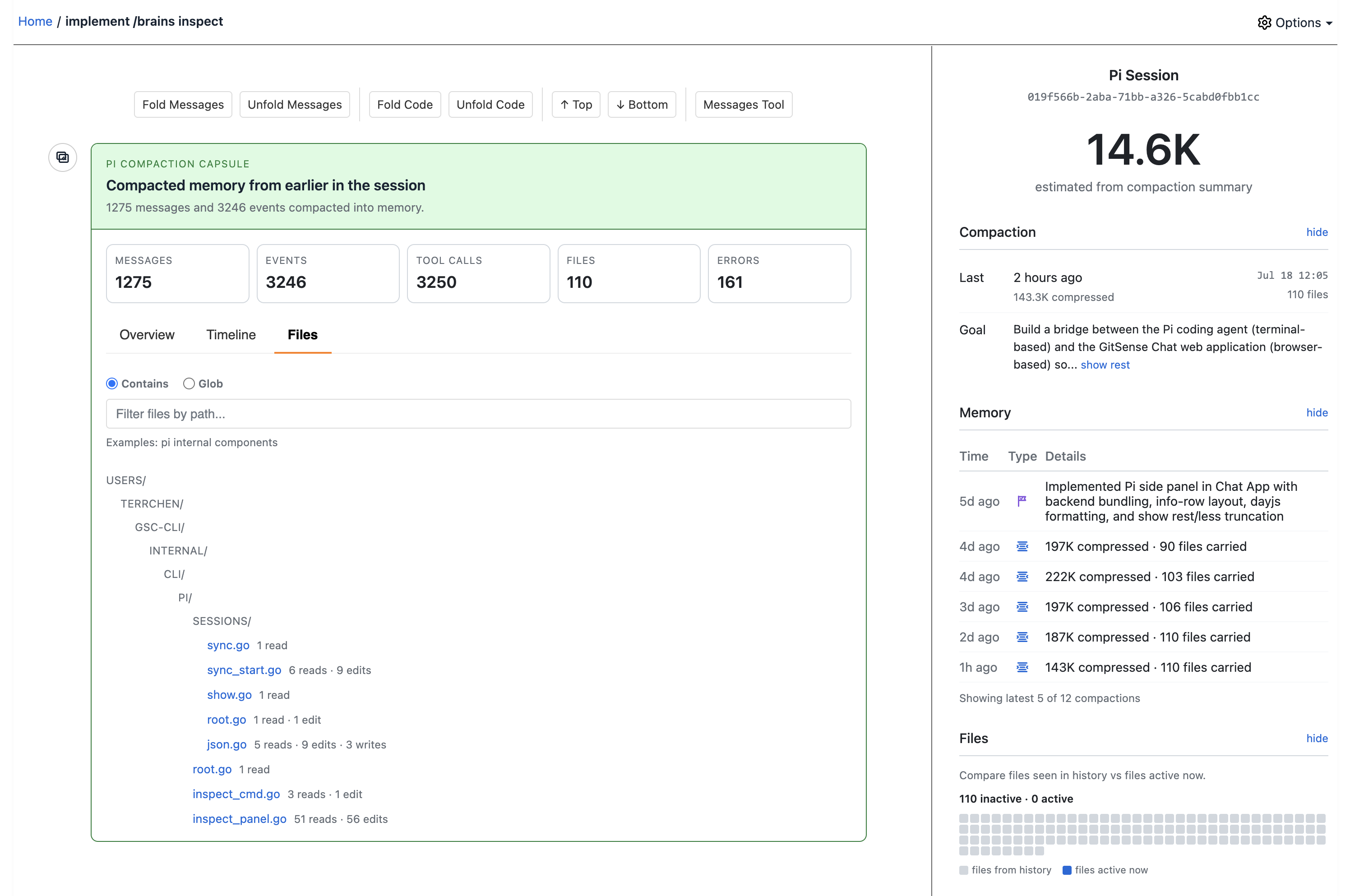
The screenshot shot above contains what I call a compaction capsule which contains all the messages/events at the point of compaction. The "Files" section in the right side panel shows me how many files were read/modified since compaction.
After compacting, I can easily tell what Pi use to know and use `/tree` to go back in time.
I still wouldn't compact more than 5 times before starting a new session since compaction messages persists in Pi.
With /compact in Pi, it creates a message that you can easily review and I am curious as to how '/protect' works.
One of the features that I am working on is to make it easy for agents to retrieve the exact message/event before compaction and I am curious if /protect is a deterministic process or if it is just instructions.
My extension for pi https://github.com/gitsense/pi-brains solves the too many skills problem and it can be adapted to work with any coding agent that supports hooks like Claude and Codex.
I think the issue is, on the surface this is very much a "watch this non-deterministic actvity" but I can see the value in it. This is self promotional but I am working on a "Brain" (https://github.com/gitsense/pi-brains) for the Pi (https://github.com/earendil-works/pi) coding agent and I can actually see this being quite useful to quickly tell if you did make an agent smarter or not.
There is obviously different ways you can do this, but I can see being able to quickly visualize changes based on additional knowledge/constraints can be quite useful.
One of the rules shows how you can inject information when you know an agent wants to read a certain file. So if you have skills related to a certain file/directory, you can inject the information when you need to.
So using the OPs visualization tool, if you find the agent wandering you could create a new rule to guide the agent and compare it with and with guidance.
which is designed around the Pi philosophy of less is better by focusing on ondemand context/guidance. I won't bloat the context unless the LLM needs to do something I know it will need better guidance with. I have a demo repo for this at https://github.com/gitsense/gsc-rules-demos
One of the examples is, if I know the agent is reading a specific file, I will inject additional context. So if the agent never needs to do something in a certain file or directory, I don't need to pollute the context with "what it may need to know".
It's difficult to be very specific, because this was not a formal experiment.
I was using LLM collaboratively to help me setting up and document a home server. I was using DeepSeek for that matter. I tried some tasks on Claude Code and some on Pi.
Subjectively, I felt that it was marginally "smarter" on Claude Code. It would figure things out better, that sort of thing.
I am still using Pi btw. My current set up is using MiMo on Pi as a planner, ans DS in Claude Code to validate/execute the plan.
I may try moving it all to Pi, but I wonder if I should learn how to better configure the things there.
> I may try moving it all to Pi, but I wonder if I should learn how to better configure the things there.
Honestly if the difference was marginal, I would move to Pi. I just tried layzpi and I had the agent write/compile a hello world in c and it required 20k in tokens. My minimal setup required 5.3k in tokens.
People will say the cost is minimal since this is cached but 15k is a lot since that needs to be reasoned by the LLM. I haven't looked at Claude Code but I read somewhere the system prompt is like 20k so I can see how Claude Code might have seem smarter as what you are working was probably addressed in the system prompt.
For me the bloat is not worth it since I am more interested in the LLM being able to reason better.
> One of the most annoying things I've seen AI do is accidentally pull in old requirements and start building off of them.
This is actually the reason for me wanting to create what I call "Brain checkpoints". After chatting with the agent and letting it do its thing for discovery, I needed an easy way to understand what it knows at any given point. What files it has read, what tool calls were made and so forth.
Checkpoints work extremely well in Pi since you can create a branch, and have the agent generate a checkpoint based on what has changed since the last checkpoint and this information will not pollute the main conversation but you benefit from the token caching.