> Third, audio quality is deeply subjective, and what sounds good to my ears may sound like total garbage to yours.
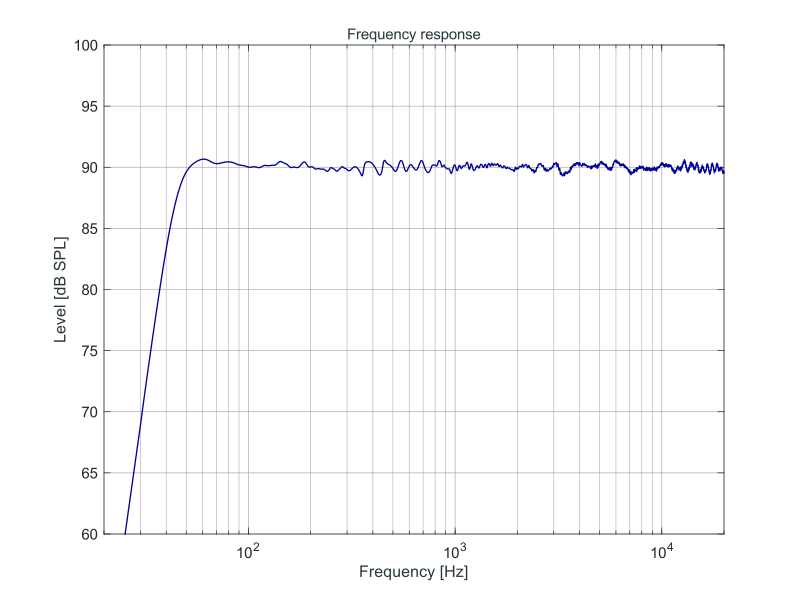
Interesting article (audio processing should be a standard OS feature), but I wish we'd stop doing this. Speakers were never subjective (unlike earphones), they’re supposed to be flat – “equalised”. At least if you want to hear the thing as it was mastered.
I think it just hurts consumers in the end, as it validates snake oil in the form of various ”enhancements”, like image processing on TVs. It makes stuff really hard to compare and much easier to sell shitty hardware.
Not that I’m opposed to improving shitty hardware with software, – quite the contrary – it’s just the murky subjectivity that irks me.
No speakers have flat frequency response. If that's the target (it usually isn't[1] even with very elaborate systems that include a great deal of DSP grunt, in my experience), then they all miss -- every single one of them misses.
All speakers have resonances that add to the sound in ways that frequency response, alone, does not measure. All speakers also have imperfect dynamic response. All speakers have imperfect impedances, which can matter quite a lot to the power amplifier that drives them. All speakers have non-linear phase response. All speakers have different dispersion characteristics.
All speakers then operate within acoustic spaces (like a room in a house) that introduce even more variables.
Plenty of exemplary (according to CEA-2034-A) loudpspeakers once you shop in the active category, including low THD/IMD at high SPL and optional phase linearization to lower group delay.
I'll bet you a beer that if we had examples of each in a room and spent the time to iterate upon setting them up in the most-optimal of ways that can be concocted, and then went through all of the motions of doing controlled, equatable, blind A/B/X listening: We'd still find that we prefer one loudspeaker system over the other.
And our preferences might not even agree, and that's OK. :)
I really suggest you get more into the NRC/Harman research about the subject. Individual preference does exist, but on average it doesn't. Same way that some people prefer more or less salt in their dishes, but you quickly converge towards a unique proportion when averaging those tastes obtained via rigorous blind testing (very important).
Said convergence happens for tonality: people do prefer neutrality as in lack of linear and nonlinear distortion (thus relatively constant directivity in order to get said neutrality when the reflected and direct sound sums).
Where there's still some considerable variation is the amount of directivity: some people prefer it wide to get stronger late reflections that give a sense of envelopment and others prefer it narrow to remove more of the room from the global sound, to hear more of the recording (like headphones).
If the research shows that there is only one optimal way to paint a portrait, or to construct a pizza, then: It is my inclination to reject it. I do not want this kind of homogenization in my world and it is my motivation to destroy it.
Consider this: most successful artists who worked outside of what is recognized as the academic classical style - impressionists, surrealists etc - were first trained very well in that reference academic style.
When you know the reference, you are free to break the rules. Otherwise you're just fumbling and drifting around.
Humans are given two brain hemispheres for a reason.
You raise interesting points and you present them well. They have interesting parallels.
One of the things I often try to impress upon others during $day_job is that it is important to always know and appreciate (and seek to find, and perhaps enhance) the very best way to do a thing.
It's not that we can't cheat. It's not even that cheating isn't sometimes adequate or permissible -- or, sometimes, necessary. Sometimes the most-proper way to achieve a thing within the confines of the constraints is to very deliberately cheat in a defensible fashion.
Like a Wilkinson combiner/splitter when used in the bidirectional RF space: It cheats. (It also works within its limitations and has great value in some applications. It's not universal at all.)
In some cases, cheating even requires review by an engineer to approve a particular method in a particular application.
But when we don't seek to know the best, most-right way to do a thing then we can't even recognize when we're cheating. When cheating and gettin'-'er-done is typical, fast-and-loose becomes the norm instead of the exception, and that's just doing ourselves (and the job, and the company, and the client) an unwarranted disservice.
And that does ultimately is just fumbling and drifting around, just as you succinctly suggest.
But standards aren't the be-all, end-all rule. At least when safety isn't a concern: They should be flexible to preference when preferences exist, and that preference extends beyond salt appropriation.
I once made an accidental purchase after a long day at work where I bought feta instead of the ricotta that I intended to buy. My family was predictably hungry when I got home and realized the depth of my mistake. So I built that lasagna anyway with the "wrong" cheese in the intermediate layers, and it turned out so excellent that I will never make lasagna any other way again. It's really lovely, and it was entirely the result of fumbling.
Or: Chicago, vs NYC, vs Detroit. These guys will never agree on what the best pizza consists of, but most of us can find an example of a pie in any of those regional styles that is lovely and satisfying to us.
It's very easy for me to accept variability in the norms of foods, and of painting styles, and of audio system implementations. I can't define a perfect guitar, or a perfect piano. These are all things that I think deeply involve emotional (perhaps even irrational) personal choice. There can be more than one way, and it's OK. We don't all appreciate the same tastes, sights, and sounds. The variability is a feature, not a bug.
But meanwhile: It's very difficult for me to accept variability in, say, electrical systems. There can be an established and objective best, safest, most-defensible way. And the method behind the walls is not the kind of thing that usually elicits an emotional response from the beholder while they plug in a lamp in their new place, so the best way can win.
Being both a technician and a musician, I couldn't agree more.
The technician in me strives to have as flat, transparent and precise audio reproduction system as possible, with the single purpose: to make what the musician in me does translatable to every other audio system out there, which may very well be quite imperfect, but still intimately known and adapted to by its listener - and thus reproduce my music without surprising the listener in a bad way.
(Funny enough, after many years of chasing that ideal, I'm much closer to it with balanced armature IEMs than with a pair of professional studio monitors at 100x the price!)
An analogy in graphics would be a display with neutral color reproduction that has as perfect black as possible and white as bright as it's sane to have.
It's a never ending quest of course, and it's the creator's one, not spectator's. Which is basically "give me pure silence and transparency so that I know precisely how much sound and color to add". How much is added is a dogma for one and total freedom for another, and that's a completely different story.
From a spectator's point of view, everything becomes much more subjective and roots more in psychology than anything else.
I always remember that interview of a vinyl mastering engineer for the Kompakt label, who said that the art of an audioengineer is that of persuasion. "This sounds awesome, trust me :)
And then, the reconstructive abilities of one's perception also mean a lot.
There's a wonderful passage from the Hesse's Steppenwolf, where the protagonist listens to a gramophone record, noisy and bandlimited, of an orchestra playing a piece, deeper and deeper until he manages to hear the original sound and intent of it through the veil of the record's imperfections.
Of course you can, but it doesn't change the fact that's there's a general preference.
Also, I'm pretty sure that even in your case, the changes you want to make are material dependent and neutrality would be more to your taste if you don't want to turn knobs with each album switch.
Now enough seriousness, if you're amongst the people who still do so, I'll look at you the same way I look at American tourists putting ketchup over all their dishes or people going to an art gallery with tinted glasses =)
> Of course you can, but it doesn't change the fact that's there's a general preference.
You haven't established that there is a general preference, though.
And meanwhile: Audio systems of every variety still usually come with some manner of tone controls for people to use. And when people make adjustments, they aren't seeking to find alignment with someone else's published idea of a good time.
Most people wouldn't know what a frequency response chart is even if someone rolled it up and hit them on their head with it. They aren't targeting things that they have no knowledge of.
> Also, I'm pretty sure that even in your case, the changes you want to make are material dependent and neutrality would be more to your taste if you don't want to turn knobs with each album switch.
Nope. I usually set my own listening systems to my preference and then leave them alone, although the more-proper stereo does have what I call a Ministry button that I engage when listening to Ministry.
So yeah, anyway. Standards. I did once put together some Python code to implement an ISO 226 equal loudness contour that worked with a hardware DSP and recomputed the curve based on the real-time position of a physical volume control.
Maybe Fletcher and Munson did have it right for what they were doing back in the 1930s, but that didn't make their work applicable to what I was doing in 2025. It was a fun exercise that taught me quite a lot, and which ultimately turned out to be a mistake.
> Now enough seriousness, if you're amongst the people who still do so, I'll look at you the same way I look at American tourists putting ketchup over all their dishes or people going to an art gallery with tinted glasses =)
Oh, yeah. Ketchup on ham sandwiches, and on eggs. Ketchup on cantaloupe. Ketchup in tomato soup. Ketchup on popcorn, and in my coffee. I garnish my martinis with ketchup.
When I drove by a Heinz ketchup factory last weekend in my giant American car, I was overcome by emotion and had to pull over. The juxtaposition was just too majestic and beautiful to behold, with the ketchup plant on one side of the road and the fertilizer distributor on the other; like the whole circle of life, all in one place. I sobbed softly for several minutes before I regained sufficient composure to continue.
> Speakers were never subjective (unlike earphones)
I don't think this has been true in my lifetime, at least. Some brands being known for "warmth" vs "brightness" is ages old, before the idea of audiophile earbuds was even a thing. At the extreme end, you can go back at least 40 years to see people with dedicated sub outputs and massively-oversized non-flat subwoofer setups.
Sure but they’ve always been mastered with the same setup, so the bar has not changed. And anything flavoured will not work universally for all types of music or other kinds of audio (like voice calls are really hard to understand with bassy speakers).
Mastering is done with the target in mind. There's tons of great videos by Masahiro Sakurai (Creator of Smash Bros.), one of which covers how they use typical household TVs to tune the audio/video for the game because relying on top-end audio/video equipment will result in worse results for the player.
Speakers, at least the great majority of them, are not flat. Can you not hear differences between speakers? Studio monitors typically aim for a flat response, but most barely make an acceptable approximation. And then we're not even discussing phone and tv speakers or the fact that a flat response for pure tones doesn't necessarily translate to one for complex sounds.
I have heard that audio engineer's don't necessarily master to a flat EQ because such a small section of listeners are listening with a flat EQ. Most are using car speakers, airpods, etc so they master it based on those expectations.
Can confirm. When I was in that world we'd have a shitty boom-box on a shelf that got pulled out for exactly that purpose. But you'd always start from the studio kit and work down, never the other way.
In my understanding, this whole thing is basically 1:1 with color spaces in display tech, except with pictures/video you at least get to encode what you targeted, versus with audio, you don't.
Yeah that's pretty good way to put it, except I'd say the average person is using way better screens with smartphones than the quality of speakers/headphones their using.
Why would speakers be any different than earphones? Botu are subjective ; I personally hate flat eq. I've listened to numerous products, some worth thousands of dollars, and I'll always take some sort of slight bass and treble boost over flat eq. I'll even take a big bass boost over no bass boost at all.
Earphones are forgoing the outer parts of your ears and skull.
Speakers don't; a "good" speaker setup with eyes closed and no wind/perceptible airflow and no smell and truthful thermal radiation surroundings is effectively indistinguishable from the real place.
Like, literally.
It's not _possible_ with earphones because you can't not feel their presence without being numb on a good bit of your head.
Tangent, but I found that a bass shaker / transducer massively improved my speaker experience without requiring a subwoofer. I built the subwoofer first, but it would annoy everyone around me and it was really spotty depending on its location, the exact layout of the room, etc. Slapped a bass shaker underneath me and it really completes the experience without annoying everybody else.
> Why would speakers be any different than earphones
There are various "ideal" EQ targets for earphones depending on what your model of an ideal audio source is. They all start with a flat response speaker, from then you can model:
- Two speakers right next to the listener's ears. (flat)
- A single speaker 1 metre away in the x axis, in an infinitely-sized anechoic room. (free field)
- Two speakers 30 cm away pointing to a plastic torso at a 90° angle, in a room with reverberations. (B&K/Harman)
- A spherical room lined with speakers, point listener in the centre with no reverberation. (diffuse field)
- An infinite wall of speakers 1 metre away in the x axis. (another method for free field)
The definition of sound quality tends to change between people.
My definition is pretty much the same as yours here, but I know quite a few people who hate listening to music on anything with a relatively flat frequency response.
I'm also doing something similar, as for over-explaining state and momentary decisions, I have yet to find good wording for it too. I had a bit of success by running a reviewer at the end to look over comments and docstrings and judge if it is "evergreen", but feels a bit like a rain-dance.
I never understood the point if having the unfathomable churn of thousands of new questions per day. The value of SO to me was always a knowledge base with reputation mechanics, and that did not change. I still default to searching before asking AI.
If you’d like to take a look at how one of the older Victorian mechanical signal boxes on this map (still) work, I can wholeheartedly recommend Tom Scott’s recent video on signalling in Britain [1].
> Both espresso samples were served at 22 °C to ensure a fair like-for-like comparison […]
> It is noted that espresso is normally consumed hot and has transient sensory attributes that are temperature- and time-dependent. Hence, serving espresso at 22 °C will alter its sensory characteristics.
This is a weird test, coffee get’s so much worse when cold. So people can’t distinguish between two bad coffees.
This is a myth. Bad coffee tastes better when hot because your sense of taste is dulled - reducing bitterness. Also, at higher temperatures, aromatics and volatile compounds are more airborne, improving the smell of coffee. Good coffee is better enjoyed around 60-70C
I meant it's better when cooled, not straight off the boil. Bad coffee tastes better when it's too hot to drink. Good coffee tastes better when it's cooled.
No way. I make espresso over ice and it's great, a lot better than cold brew. The Greek make just about any coffee using the espresso machine over ice and Koreans are quite fond of their iced Americanos, which are a bit dilluted for me but I also enjoy them from time to time. I also made Aeropress over ice with specialty coffee and its was better than the hot drink prepared using the same cofee and recipe. I just do it during summer when one would normally enjoy ice cream, the rest of the time I drink the usual hot espressos.
Room temperature coffe is just like room temperature water: boring.
Our espresso machine (De'Longhi) makes cold brew in like a minute or two. Brilliant. It's tastes like normal cold brew but I enjoy espresso over ice better. Maybe this ultrasonic espresso machine could achieve better extraction with cold water than purely pumping water at high pressure through coffee?
Anyway I'd be quite excited to see a review by James Hoffmann when it hits the market.
"Good" (well-extracted) coffee is still relatively good when warm, especially compared to "bad" (over-extracted, or under-extracted) coffee. That said, many believe that the optimal temperature for serving coffee is 50-60 degrees celsius (122-140 degrees fahrenheit).
Yes, but the test was at 22°C, which I wouldn’t consider warm. And it’s too cold for the differences to be even perceptible well, making the test flawed. Disregarding the fact that it’s also much colder than people use to drink coffee, making it even harder to distinguish for non-experts.



reply